
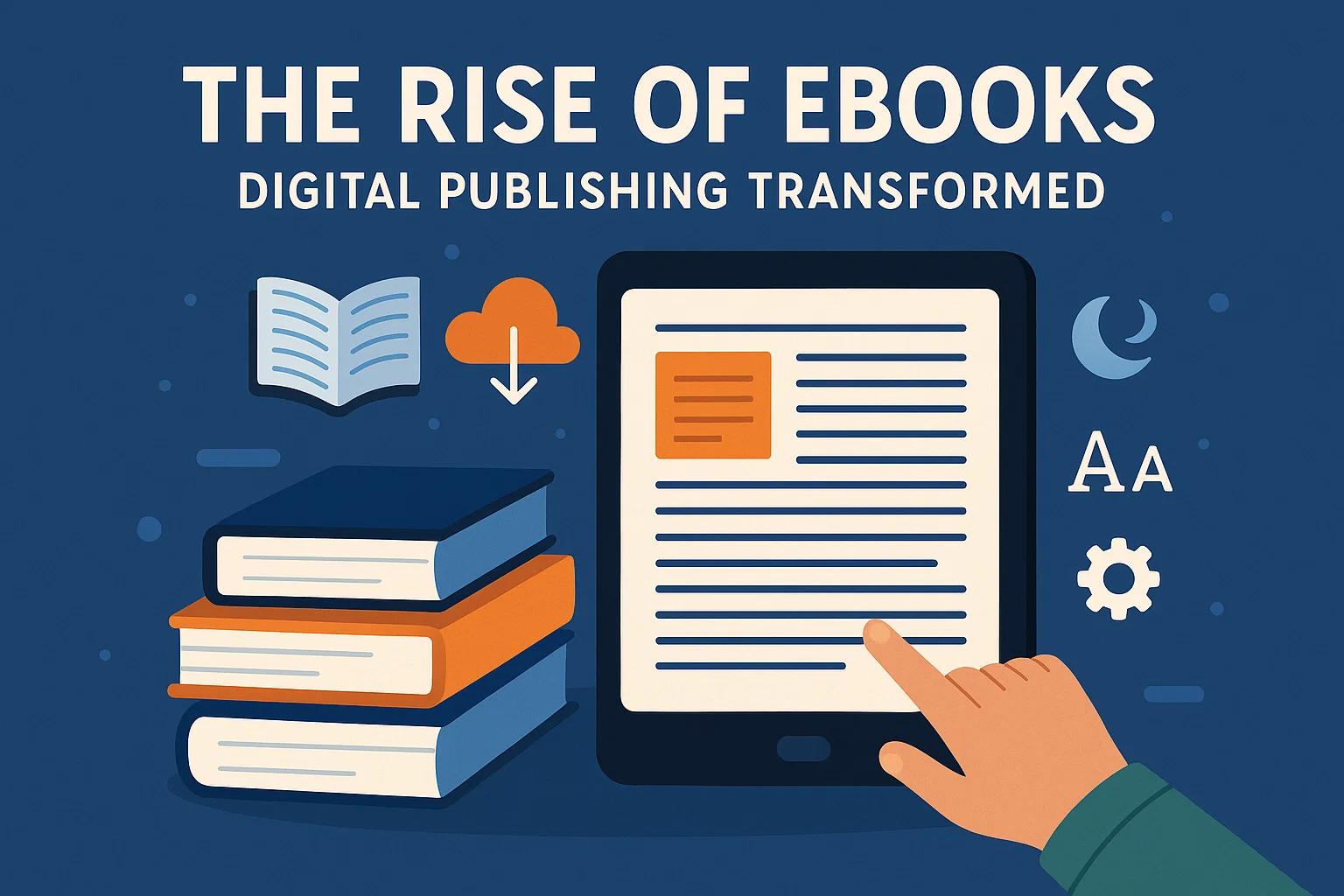
A digital version book with a fascinating plot, mesmerizing book covers, and strong characterization is a real page-turner that keeps avid readers completely engrossed. Due to their portability, convenience, and seamless reading experience, e-books are more preferred by contemporary authors and readers. A Pew Research study (2025) states that e-book adoption is growing globally, although the rate fluctuates; 75% of readers in the U.S. favor e-books. The number of e-readers is expected to surpass 1 billion worldwide by 2027. Many hybrid readers opt for both print books and e-book versions to gain a multisensory reading experience, enriching comprehension and improving memory retention.
Self-publishing authors who have recently joined the publishing industry might lack knowledge about the lucrative publishing benefits of e-books vs. audiobooks, vs. print. Paperback or hardcover books are visually appealing for readers, offering a tangible experience with reduced distractions and increased focus. The emergence of e-books has revolutionized the content creation, editing, publishing, reading habits, trends, and the consumption of literature. E-books, a transformative trend in digital publishing, allow authors to bypass traditional gatekeepers and adapt to self-publishing platforms. Independent authors have attained creative autonomy in book production, editing, and publishing in numerous digital formats.
The integration of technological advancements, including AI algorithms, has led to the creation of audiobook narration and interactive e-books with multimedia and other online reading resources. The portability and cost-effectiveness of digital format books signify that they are less expensive than printed books. Additionally, readers have fast and easy access to read e-book versions through a tablet, an e-reader, or a smartphone. These lightweight electronic devices have a huge storage capacity and store countless books, which makes reading convenient. A subscription model allows indie authors to access e-books through websites and digital libraries for free reading and downloading the preferred manuscript. Modern digital publishing trends have helped authors in increasing book discoverability and boosting the targeted audience’s buying power, and instilling positive reading habits.
E-books have transformed the reading habits of readers of different genres by providing accessibility and the convenience of reading and buying their own copy. Reading different forms of manuscripts, such as fiction and novels, helps writers know about storytelling elements such as story structure, plot, develop a unique writing style, and expand their vocabulary. While flipping a wide range of e-books, young fiction writers and novelists get inspiration to develop unique and creative ideas to incorporate fresh perspectives and ideas to develop compelling storytelling.
Digital versions offer a customizable reading experience, allowing readers to adjust the font size, style, and screen to gain a captivating reading experience. With the integration of AI technology, such as AI narration and AR and VR technology, readers of different abilities interact with the content and develop a strong emotional connection with the story. A recent statistic highlights that the global audiobook market size reached $8.70 billion in 2024-25. It is expected to increase to around 1.76 billion by 2030. Tech-driven Gen Z and Alpha teenage readers and the audience of the 25-34 age group have developed the habit of reading e-books and print manuscripts. While engaging in household chores or travelling, they find it convenient to listen to audiobooks instead of carrying heavy printed manuscripts.
An extensive utilization of smartphones and subscription-based streaming models such as Audible, Spotify, Apple Books, and Storytel has accelerated e-book and audiobook production. Additionally, e-book authors and publishers have acquired the opportunity to tap into the global e-book market, boost their brand visibility, and gain revenue of about $9 billion for audiobooks and $14 billion for e-books in 2025.
The Evolution of Reading and Publishing
Ancient Transcription Mode and the Printing Press Revolution
The book publishing industry has undergone a revolution over the past few decades. In the medieval era, early authors crafted manuscripts on papyrus, parchment, or silk. The old texts stockpiled in temples or forts were accessible to priests or scholars. Later, the 15th century brought about the printing revolution. It was triggered by Johannes Gutenberg’s discovery of the mechanical movable-type printing press in Europe in 1440. Gutenberg’s printed books reduced the cost and time of book production and were accessible to a broad and diverse readership. The availability of reasonably priced manuscripts and scripts transformed reading habits and boosted curiosity in people to purchase books of their favorite genre. The rise of the press initiated movements such as the Renaissance and the Reformation, which made knowledge and learning accessible to a broad audience across Europe.
Industrialization led to Mass Market Publishing
The 20th century marked a substantial transformation in the publishing industry. The steam-powered presses led to the mass printing of paperbacks, including sensational novels and fiction. The printing of these genres of books involves low-quality printing paper along with simple and minimalistic cover designs. These softback books were lighter and smaller in size and are affordable for a diverse audience. Mass-market publishing also introduced another advancement in printing, such as the offset printing press, which led to the quick production of a wide genre of books. Publishing transformation also offers autonomy to independent publishers and authors to establish publishing houses, book clubs, and reading forums.
Professional book publishing services such as Penguin, HarperCollins, Random House, and David McKay Publications became the primary gatekeepers of culture and literary production. They build connections with new and experienced authors and facilitate them through the prewriting, planning, and drafting phases. The editorial team reviews and modifies the text and structure of the manuscript. Book publishing experts properly format the manuscript for print or publishing format. The publishers help authors select an appropriate publishing path and adopt the literary voice and style that resonates with potential readers. The renowned publishing services transitioned from start-ups and gradually grew into global brands have democratized reading. They help potential readers boost their visibility and enhance the book’s discoverability in the niche book market. Companies like Penguin and Random House pioneered the trade paperback, made the accessibility of books much easier for a wider audience.
Rise of modern eReaders
Self-publishers and authors utilize early digital publishing platforms such as Amazon Kindle and Lulu to create digital-format books. Book Publishing on Amazon allows independent publishers to self-publish their books with ease. They flexibly upload and convert the files into different publishing formats. The published manuscript reaches global Amazon stores within 24-72 hours, making it more accessible for a wider audience to discover new books and purchase e-book, paperback, or hardcover books.
Digital publishing platforms also introduced electronic devices, such as Kindle, e-readers, Nook, Kobo, tablets, and smartphones. These modern e-readers provide greater convenience for storing and reading numerous books on a single device.
Amazon Kindle enables self-publishing authors to connect directly with readers by offering a diverse range of books at competitive prices. Moreover, Amazon’s subscription service for e-readers further incentivizes a vast audience to opt for the Kindle Unlimited subscription, which provides unlimited access to a large catalog of e-books, audiobooks, newsletters, and magazines for a monthly fee. Kindle e-readers can read 20 titles at a time on any free Kindle app on various devices.
The other evolving digital publishing sites, such as WordPress, Issuu, and Apple Books, made online content reading more accessible for global readers. E-books of different genres are available in different formats, including PDF and illustrated books. The platform also offers access to a digital library that helps in discovering and engaging with writers and their publications.
In a nutshell, the digital revolution has streamlined the publishing industry. Developing new business models, book writing services, and distribution channels have expanded the accessibility of books to numerous physical bookstores and online retailers. They provide a massive collection of books to a global audience at their fingertips. Likewise, virtual libraries with a vast database help readers to discover and comfortably read the preferred e-book on a single e-reader or mobile device. Along with e-books, the audio listeners also gain an immersive AI audio narration experience.
Factors Driving the Popularity of E-Books
Convenience
Let’s suppose you are a first-time author and planning to publish your premiere novel. You may desire to publish your dream book, employing your creative autonomy. To gain exclusive publishing guidance, you may seek professional assistance from a leading publishing company, such as David McKay Publications. The expert publishers and authors facilitate new writers to choose the publishing path and further assist them with Amazon publishing. As compared to printing books, online publishing is quick, affordable, and convenient for indie authors. Instead of waiting for weeks for book production, editing, and design, and time time-consuming printing process, self-publishers can flexibly create and publish books within a few minutes.
The self-publishing platforms, such as Amazon KDP, Apple Books, Barnes & Noble Press, and Kobo, format, publish, and distribute books speedily. Moreover, the digital publishing platforms have produced portable and user-friendly e-reader devices. The reading apps, such as Amazon Kindle e-readers, Kobo Libra Color, Barnes and Noble Nook e-reader devices, and Nook reading apps, are compact and have a high capacity for storing numerous books in a device. Readers can flexibly download the Amazon Kindle or iBooks and adjust font size, background color, and adapt screen size and brightness to reduce eye strain.
Additionally, Professional book publishing services guide authors about selling and distribution of e-books. They can directly sell digital format books with major online retailers or leverage digital publishing platforms and specialized distribution networks for disseminating books to a wider audience. The readers also visit the author’s website, browse the latest titles, download and read the preferred e-book version, or make an online purchase through the site.
Cost-Effectiveness
With e–book publishing, amateur writers encounter lower publishing costs compared to print. The distribution of paperback or hardcover books involves warehouse, shipping, and logistics expenses. Conversely, e-book publishing comes up as a budget-friendly option for self-publishers with limited resources. The authors have full creative control over book production, editing, and design. Moreover, utilizing online publishing platforms flexibly convert files into different formats and instantly publish the manuscript. Digitally published books promptly reach the global book market, expanding book reach and boosting an author’s credibility.
Easily Make Modifications to the Pre-publication Version
E-book publishers have the convenience of updating the final draft before publishing. The publishing supervisor reviews the manuscript in detail, identifying minor errors and typos. They revise a chapter to improve vocabulary, add images, and details that make the book engaging for readers. The designers enrich the book covers and back matter with publishing details and a website link. Once the publishing team makes adaptations to the finalized manuscript, they upload the file for publishing. In the case of print books, a publisher faces the risk and cost of reprinting to make relevant changes in the final print book. If books are printed, the text is difficult to change. Whereas, ebooks can be updated at any time with no paper waste or additional publishing expense.
Subscription services (Kindle Unlimited, Scribd, etc.)
Professional e-book writing services offer subscription models to e-readers to leverage a vast library of e-books for a monthly or annual fee. Subscription services of Kindle Unlimited allow users to utilize a repository of information of e-books and audiobooks through their online catalogs. The subscription service offered by Scribd involves providing access to a large database of e-books, audiobooks, magazines, and podcasts for a monthly fee. If readers opt for the Kobo Plus subscription model, they can read new and updated content related to the existing and upcoming e-books and audiobooks. With Storytel, the readers get unlimited access to extensive audiobooks and e-books. The key goal for introducing subscription models by professional publishers is to increase a book’s visibility and sales and grab new readers’ attention.
Environmental Impact
As compared to print books, digital format books are eco-friendly and have come up as a sustainable choice for numerous readers. Environmentally conscious readers prefer reading digital books, with no paper, ink, or carbon footprints. They use e-reader devices to download the required book instantly for reading or conducting research. Thus, e-book formats eliminate the materials wasted in printing and shipping, and prevent physical books from ending up in landfills.
How Digital Publishing is Changing the Reading Experience
Personalization
Whether you are a first-time author or a reader who desires to gain a personalized reading experience, you can employ e-reader devices or AI algorithms. Reading apps and devices serve as gateways for readers, offering them a customized and convenient reading experience. Modern e-readers are designed with the storage capability of more than 1,000 books. An e-reader having built-in dictionaries helps authors and readers to enhance vocabulary and highlight important passages to be used for manuscript writing. The users flexibly adjust reading settings as required, such as changing fonts, background color, and size of interactive content. Individualized reading offers a seamless, comfortable reading journey. Reader-centric features in electronic devices allow readers to download books instantly for purchasing or reading, eliminating shipping and other logistical expenses.
Multimedia Integration
Traditional text-based storytelling might not be as compelling as compared to visual storytelling. To let the published book, get more visibility, experienced book writing services create transmedia storytelling. It involves incorporating interactive elements such as videos, audio clips, images, animations, interactive quizzes, articles, and hyperlinks. The embedded visual components help readers learn about the book’s theme, plot, and characters. Multimedia integration allows authors to move beyond traditional storytelling modes to explore digital storytelling that brings narrative to life. E-books with multimedia integration shared across multiple self-publishing platforms and other online forums enhance global reader engagement, lead to a fast market expansion, and increase sales.
Social and Interactive Reading
Interactive e-books integrated with digital documentaries with audio and soft background music, embed animations, videos, and interactive 3D models, keep readers engrossed in the interactive storytelling. Professional publishers blend e-books with AI algorithms, such as augmented reality and virtual reality, to blend digital content with the real world. AR and VR completely immerse users in the digital narrative. Modern readers interact with the immersive content using VR devices such as headsets and VR glasses. Highly interactive storytelling helps readers to delve into the story, bringing an immersive and motivating reading experience for booklovers of all ages.
Along with interactive reading, e-books also boost social collaboration between authors and readers. Versatile, high-quality published manuscripts distributed in libraries, online forums, book clubs, book writing services, and reading platforms allow global readers to join these forums and participate in various literary activities. It includes attending Q/A sessions, book forums, and discussions with the author reading community. Organizing a book discussion group allows readers of a similar genre to discuss different aspects of the chosen book.
Social reading platforms connect readers to an online book club to interact with a diverse literary community. Voracious readers attend virtual reading events and share their insights and experiences after reading the book. They leave their reviews on the review sites that further incite new readers to download the book to read or instantly purchase through the author’s website.
Impact on Authors and the Publishing Industry
Availing Self-publishing Opportunities
Getting a manuscript published appears to be a daunting task for first-time authors. They have no idea of e-books vs. audiobooks vs. print. Encountering various publishing challenges makes it difficult for novice writers to choose a lucrative publishing path. To make strategic choices, allow authors to hire professional publishers who help authors navigate different publishing paths, such as traditional, self-publishing, and hybrid publishing. If new authors opt for traditional publishing, the publishing house facilitates them throughout the publishing process. It includes book production to editing, formatting, cover designs, and offering marketing and distribution support to self-publishing authors.
Struggling to find a literary agent for book publishing and encountering high production and distribution costs induced many professional writers to shift their perspective toward self-publishing. E-book platforms such as Amazon Kindle Direct Publishing, Smashwords, Barnes & Noble Press, and Draft2Digital have democratized publishing for indie authors. By sidestepping traditional gatekeepers, including book agents and major publishers, independent authors attain creative freedom and control over the book publishing process, setting appropriate pricing, marketing of printed and e-books to readers across the globe. The online publishing sites make faster publication in contrast to traditional publishing, which takes a prolonged time. Furthermore, e-books are distributed and sold to a global audience through websites and online retailing. For the delivery of print publications, self-publishers use print-on-demand services. POD prints the required number of books. Digital platforms dispatched paperback and hardcover books through distribution networks to readers located in different geographical areas.
Read more on our Medium blog: From Print to Pixels — The Evolution of Digital Books.
Opting for Hybrid Models
Independent publishers and authors are now increasingly opting for hybrid publishing as an established and lucrative alternative to the traditional and self-publishing path. Combined with both traditional and digital models, the hybrid publishing route allows indie authors to pay an upfront cost to avail professional services such as book editing, cover design, and marketing. Though authors pay an initial amount to publishers, they maintain their publishing control. Professional publishing services ensure high-quality control in publishing and distribution of books to major retailers and libraries. Hybrid publishing offers a feasible path to new publishers as hybrid publishers share the initial financial burden and risks. They facilitate new publishers to create more compelling marketing campaigns that increase online book sales and expand book reach in the international book market.
Negative Impact of Modern Publishing
Digital Piracy
Along with the potential benefits of digital publishing, publishers also experience adverse effects. Copyright and piracy issues have increased at an alarming rate. Digital files are easily reproduced and modified. The pirated material instantly reaches the book market through an unauthorized distribution system. It directly impacts book sales and revenue, with reduced royalty rates for self-published authors. Professional publishers who fail to adhere to ethical publishing standards damage the credibility of the published works and also reduce readership. Since online buyers look for a reputable writer’s publication, they search the author’s website to gain additional knowledge related to the upcoming release. Lack of transparency in publishing makes it difficult for average readers to make informed decisions about purchasing an e-book or printed version.
Market Saturation
An oversaturated market with innumerable new titles publishing daily makes it difficult for readers to choose high-quality books that resonate with their genre and taste. With increased market competition, new authors and publishers are facing challenges to maintain their market credibility and also increase their publication discoverability on Amazon and other self-publishing sites. The crowded market forces publishers to initiate compelling marketing strategies to tap new book markets and establish their authority and expertise.
Innovations in Digital Reading
The world of digital reading is transforming, offering interactive, convenient, and personalized reading experiences to a global audience. Significant innovations in digital reading include interactive e-books that are integrated with multimedia elements. Embedded videos, audio clips, animations, and hypertextual links make content highly engaging for younger readers. AI-Powered reading assistants, electronic devices, and AI reading apps with a friendly interface offer a personalized reading experience. The readers flexibly adjust font size and style, and change the background color and brightness as preferred by the reader. Kindle Scribe or Kobo e-readers with advanced stylus support interpret complicated texts.
E- books integrated with Augmented Reality and Virtual Reality technology bring a versatile reading experience. Interactive 3D Models comprising 3D illustrations in books, audio narration, and videos blended with digital content make the narrative more captivating for readers. Reading beyond imagination through immersive environments helps authors and readers to explore and visualize the story and come up with creative ideas and fresh perspectives to develop compelling storytelling.
Recapitulate
If you have recently launched your own e-book publishing company, you may be aware of the significant advantages the self-publishing path offers to indie authors. For instance, digitally formatted books are economically viable, convenient, and easily accessible for readers, authors, and publishers. Independent authors enjoy creative freedom in managing the entire book publishing process themselves. An online publishing platform facilitates seamless file conversion, transforming files into various digital formats and instantly publishing and distributing books to a wide audience. Indie authors facing financial constraints opt for e-book publishing for lower production and distribution expenses. The motivation for young readers to choose e-books is due to their convenience. Readers can download e-books onto a tablet or an e-reader. These electronic devices are portable, enabling readers to carry numerous books in one device. Digital books can be downloaded instantly, making them available to read from virtually anywhere. One of the reasons that entice readers to choose e-books is their affordable pricing. In comparison to physical books, e-books are less expensive and often available for free online reading. Established publishing houses are also embracing the self-publishing route, as it eliminates costs related to production, shipping, and logistics, enabling direct distribution to a large audience while bypassing traditional gatekeepers.
As digital technology continues to transform the digital reading landscape, professional publishers and authors ensure offering engaging, personalized, and accessible reading experiences. They incorporate augmented reality (AR), virtual reality (VR), interactive 3D models, and multimedia elements into storytelling that turns passive reading into a dynamic and immersive experience. Cutting-edge digital publishing platforms are making reading a communal activity, encouraging audiences to establish a digital community. Online book clubs and discussion forums allow readers from various cultures to connect and engage in conversations. Collaborating with peers worldwide enriches the reading journey, fostering creativity and broadening knowledge and understanding.
YOU MIGHT ALSO LIKE

The Author’s Checklist Before Publishing a Book
If you are a first-time author who aspires to bring out your first publication in the market, you should be
How to Become a Bestselling Book Publisher with Amazon Publishing
Let’s suppose you are an independent publisher with a zero brand presence; you must be planning to adopt a strategic

Your First Book Deserves Better: How to Choose the Right Self-Publishing Service
I. Introduction: Why Your First Publishing Decision Matters Finishing your first book feels amazing. There’s relief. Pride. A little disbelief.