

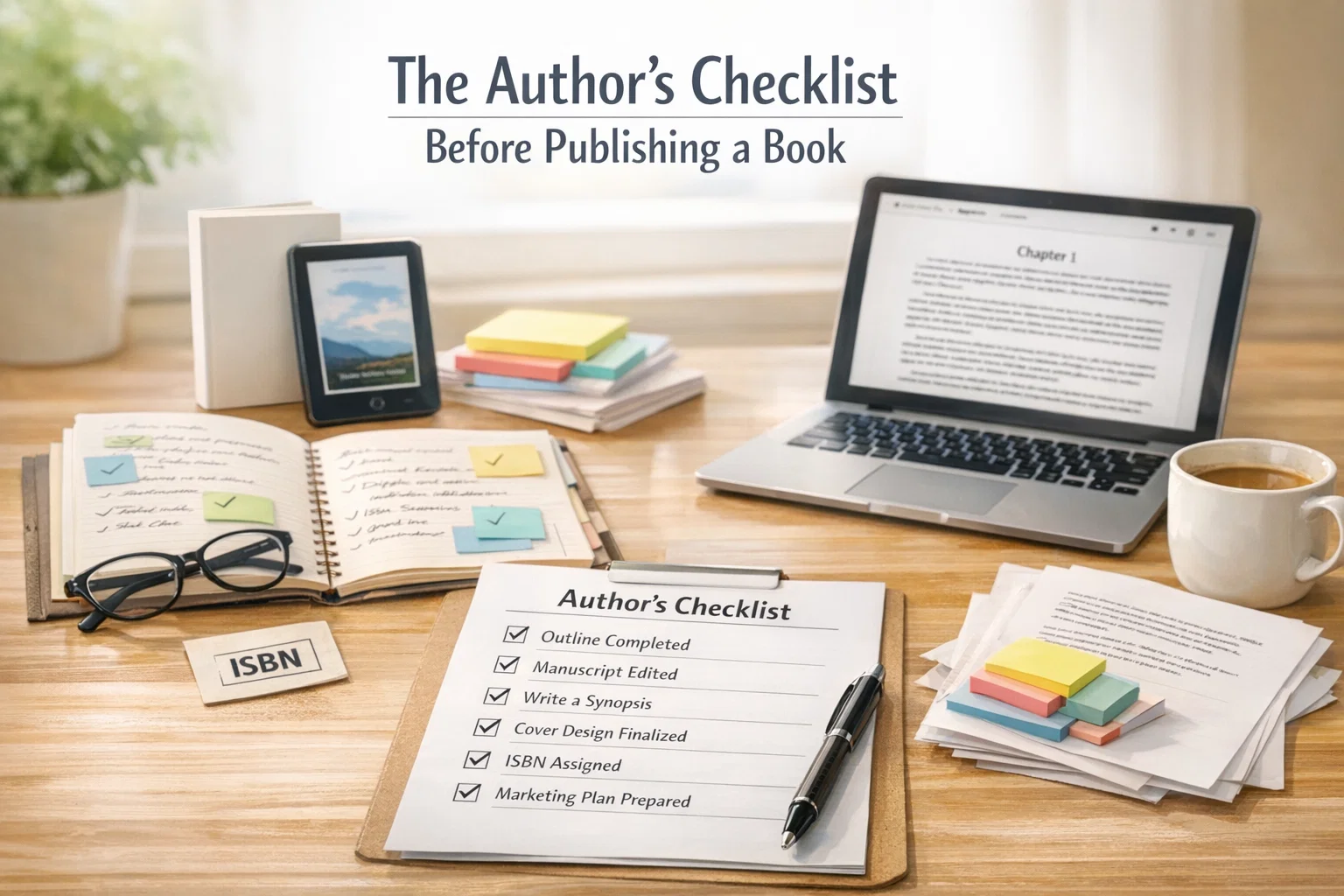
If you are a first-time author who aspires to bring out your first publication in the market, you should be aware that the publishing workflow is a lengthy, arduous, and multi-stage process. Your journey from conception to publication involves a manuscript brainstorming process. The author reflects upon the topic, creates an outline of the book, and generates an initial draft. A raw version follows self-editing and professional proofreading of the content, and the book is then designed with stunning covers. At this stage, the formatters and publishers collaborate to transform the manuscript file into the required e-book and print format. Additionally, they add metadata, pricing, royalties, and legal and tax essentials to meet publishing criteria. Post-publishing efforts include a book marketing campaign, launch, and post-launch activities.
Crafting a narrative is stimulating and deeply rewarding; therefore, it requires a comprehensive publishing checklist plan. The e-book publishing guide helps novice authors in finalizing the manuscript through editing, designing a professional book cover and layout, book formatting, and getting ISBNs to boost book discoverability worldwide.
First-time authors have no idea of the manuscript submission checklist. Being hyperexcited, they hastily complete a book, skipping professional editing. They think that the initial draft composed is a perfect piece of writing and needs no revision and copyediting. Overlooking the minor grammar and syntax errors, plot holes, and poor flow and transition in the text does not give a polished look to the book. New authors rush into writing without performing extensive research on readers’ interest in a specific genre and changing market trends. Consequently, the published book fails to get sufficient readership and gets a low-grade book valuation.
Another mistake is the non-standard formatting and organization of the book. It includes substandard cover designs, incorrect fonts and margins, non-sequential page numbers, and improper formatting for both digital and print versions. Underestimating marketing strategies such as inconsistent pricing, ignoring metadata, and unappealing marketing campaigns fails to attract an audience and brings lower conversion rates and leads.
Without utilizing a clear pre-publication checklist, even bestselling manuscripts are held back by publishing houses for major publishing flaws. If such books are self-published, they fail to entice the existing readers and new audience due to unprofessional book covers, weak editing, messy formatting, and unattractive book marketing and launch activities. Readers may not prefer buying a dry and unwieldy volume; consequently, the book remains undiscovered on the bookshelf. That is why a structured, practical checklist is considered essential before stepping to book publishing and launching.
Finalize the Manuscript (Not Just “Done”)
To create well-structured and highly poised content, novice authors are required to develop a preliminary draft. The key goal is to get the story out of the head and onto the page. Instead of rushing toward preparing a publish-ready manuscript, a beginner must focus on completing the full draft. The first draft appears to be fragmented, as it lacks clarity and logical flow. The narrative includes inconsistent formatting, grammatical and punctuation errors, jumbled-up ideas, and redundant sentences.
Writers like David Mckay Author advocate completing a raw but honest first draft before worrying about perfection. The first draft appears fragmented, as it lacks clarity and logical flow. The narrative may include inconsistent formatting, grammatical and punctuation errors, jumbled ideas, and redundant sentences.
If authors plan to write fiction, they must incorporate structural, narrative, and stylistic elements that keep readers engaged. Focus on creating a simple draft with an engaging plot, fast-paced action, and compelling characters. Set an evocative setting, adding conflict and tension that moves the story forward. Keeping small, achievable daily or weekly word-count goals prevents the writer from being stuck and finalizes the draft with intense focus.
Professional Book Editing (Non-Negotiable Step)
Some authors prefer self-editing of the manuscript. It involves multiple levels of editing that may seem daunting and difficult for inexperienced fiction writers. To gain competency in editing, the writer must employ a keen eye for detailed evaluation of the narrative. Acute editorial judgment allows an editor to review the draft in three phases, such as developmental, line editing, and copyediting. To perform developmental editing, the publishing supervisor looks for the big picture, such as the structure and consistency in the text. They analyze each chapter and its purpose and improve flow and logical progression. A developmental editor adjusts the pace of the plot and builds up conflict and tension. The other editing includes checking language and style, such as creating chirpy and bright dialogues and removing long, confusing sentences, cluttered paragraphs, and filler words in the chapter.
Line editing of the narrative covers sentence structure, word choice, consistency, and flow of the content. Choose simple and easy-to-understand word choice. Remove complex words and phrases, and highlight excessive use of adverbs and passive voice to make the content clear and impactful. Hence, the line editors ensure the narrative voice is consistent and fits the genre.
Copyediting allows the editorial experts to review the grammar, syntax, spelling, and punctuation errors in the manuscript. If the author lacks editing skills, they might hire book editing services. New publishers keep a sufficient amount to hire professional editors. Specialized editors use editing tools like Grammarly or ProWritingAid to check basic grammar, spelling, and punctuation errors and improve the style and tone of the text to enhance the readability of the content. The editing software also maintains character consistency, generates scene beats, removes redundant scenes, and enhances pace and story development.
Proofreading: The Final Quality Check
The final publishing a book involves proofreaders and formatters to check surface errors covering misspellings, typos, improper punctuation, and capitalization inconsistencies. Validate any significant structural problems, such as content consistency and spacing, right before publication. The experts improve the book interior layout including crafting a captivating, genre-appropriate book cover design and striking typography. They also use high-resolution graphics and visual hierarchy to draw the reader in and encourage them to finish the book.
Checking major structural issues just before publication includes consistency and spacing issues in the content. Formatting and layout issues and improving cover design elements, such as creating an engaging, genre-appropriate book cover design and impressive typography. Add visual hierarchy and high-resolution graphics to hook the reader’s attention toward the book.
Book Formatting (Print & E-Book)
Print Book Formatting
If the author is submitting a printed manuscript to a traditional publishing house, they have the option to hire professional book formatters who competently evaluate and fix the formatting checklist. The reason why new authors choose David Mackay Publication’s formatting services is the experienced formatters who use design and formatting tools such as Kindle Create, Vellum, or Calibre to turn raw manuscripts into refined, industry-standard, print-ready PDFs and digital versions comprising EPUB and MOBI. The professional typesetter adjusts the font style and size and proper line spacing and sets standard margins of 1 inch on all four sides.
The experts polish the paragraph structure, which incorporates scene breaks and first-line indents. Make striking chapter headings and subtitles with a consistent style. They add graphics or design components that extend to the page’s edge. After trimming, the formatters make sure the image fills the entire page.
Page numbers, book titles, and chapter names are placed in headers and footers. Consistent placement of front and back matter is another crucial important aspect of formatting. The typesetters include the dedication, table of contents, title page, copyright page, and prologue or foreword in the front matter. While back matter comprises acknowledgments, about the author page, an index or a bibliography.
E-Book Formatting
Regarding Kindle e-book formatting, the publishers changes the JPG or TIFF of the book’s interior layout and front covers to KDP. They add metadata that includes relevant and engaging keywords that match the targeted readers choices and reading trends. Choose the category of books that help increase the publication ranking on Amazon KDP. Add a compelling concise book description that include the plot, briefly introduce the fiction characters and their role in the narrative, the theme and settings and important events that captures attention. To boost reader’s curiosity, add reviews, and appropriate pricing that invite the readers to buy or instantly download the book and start reading the narrative.
The last thing is to add an author bio. It includes the author’s qualification, present and past writing experiences and list of publication that help boost the writer’s credibility and market value.
ISBN, Copyright & Publishing Details
New authors and publishers can learn technical, legal, and publishing details about ISBNs and copyright ownership law by using e-book publishing guides. The authors are required to purchase separate ISBNs regardless of how many publications they have published. Having a unique ISBN for every format, such as paperback, hardcover, e-book, and audiobook, helps the author to identify their books among other bestsellers. An international standard book number helps retailers, bookstores, and libraries to discover the manuscripts and distribute them to potential customers. With an exclusive ISBN, the marketers also do accurate sales tracking.
Amazon KDP Setup Checklist
If you plan to publish e-books through Amazon, you may opt for professional book publishing services. The experts provide self-publishing checklist that guides you through every step of self- publishing. Manuscript preparation checklist allow new authors to choose an appropriate publishing platform such as Amazon KDP or IngramSpark that meets their publishing criteria. Begin by setting up a publisher’s account on the chosen platform, enter their legal name, address, and phone number. Provide tax ID, banking info, and valid email.
Book preparation checklist include using Kindle Create tool to format manuscript file in print and digital versions such as DOC/ PDF, EPUB and MOBI. The designers create paperback/hardcovers that include back spine, and front cover at 300 DPI. E-book cover design include a high-quality JPG or TIFF image. Before uploading the file, the formatters adjust fonts, margins and bleed. Add metadata comprising a compelling book description, keywords and categories and list suitable price.
Pre-Launch Preparation
A Soft Launch Strategy
Professional book publishing services create a detailed pre-launch preparation checklist that ensures that the marketing, sales, and operational strategies are coordinated prior to releasing the publication. Key components involve setting specific, measurable goals (KPIs) to increase sales and organic traffic. Perform a market analysis to determine the target audience, their reading preferences, trends, and purchasing attitude. Establish a suitable pricing structure that includes early bird discounts or subscription levels by utilizing the Kindle Unlimited service. It provides a 90-day complimentary subscription for e-readers to read and download books. A Kindle Countdown promotion offers discounted books for a short period. Emerging authors or publishers can enhance their book marketing through the KDP Select promotional package offers, which feature higher royalties linked to sales performance.
ARC (Advance Reader Copies)
The checklist for pre-launch preparation consists of creating advance reader copies. ARCs are distributed to reviewers, bloggers, and readers to create excitement and generate buzz around the upcoming release. ARCs are available in ePUB and PDF formats and are sent to prospective clients 3-4 months prior to launch. The marketers use email or social media platforms like Bookstagram, BookSprout, BookSirens, or NetGalley to distribute pre-release copies to a large literary audience.
Gathering Early Reviews
The marketers add a polite note at the end of the ARC motivating new and potential readers to leave encouraging reviews and also post positive ratings on review sites such as Amazon, Goodreads, and other platforms. Promotional team also encourage the audience to interact and discuss different aspects of the book on platforms like Reddit or Facebook groups.
Pre-Launch Pricing Strategy
To boost book sales, the marketing experts implement different pre-launch pricing strategies. It includes setting a low price of e-books at $0.99 for the first few days to increase book discoverability and ranking on Amazon. Offer a pre-order price to encourage new readers to purchase their copy. To encourage readers to obtain the new release offer, reverse coupons and offer promotional giveaway items. They include branded bookmarks, stickers, postcards, and custom tote bags. Other items include character art prints, coffee mugs, and pens. Digital giveaways comprise low subscriptions to read free chapters or download books for free using Amazon KDP.
Post-Launch Essentials
Monitoring Reviews and Feedback
The authors get involved with monitoring reviews and feedback once a book is launched. The ongoing feedback process serves as social proof to potential readers, making it easier for them to search for their required book on Amazon. Having numerous constructive reader responses increases book visibility across the globe.
Updating Metadata
To increase book ranking and sales on Amazon, the authors are required to modify metadata and make relevant changes in pricing and categories. Add a new email and include new details about the author’s publication. Moreover, the marketers should improve book descriptions and keywords to make metadata more appealing for new readers. Add social media hashtags that boost engagement.
Launch Week Activities
The campaign includes organizing book signing events, book fairs, and conducting other launch activities. Publishers must uphold their social media engagement by organizing virtual events like Ask the Author, live readings, Q&A sessions, podcasts, and interviews with authors. Utilize BookBub for short-term e-book promotions to boost revenue. Social media marketers initiate campaigns using teasers, social media updates, and book trailers shared on Instagram and Facebook. The marketers provide social media promo codes, which include shareable codes for discounts advertised via social media platforms
The promotional campaigns feature sponsored ads that show up in search results and on product detail pages to advertise book listings. Banner advertisements showcase a brand emblem paired with an appealing headline. The streaming television advertisements, online video promotions, and Amazon DSP’s video and audio ads on Amazon platforms helps in enhancing the visibility of the book.
Should You DIY or Hire Professionals?
If you are a debut author without experience in publishing, it’s essential to seek an ultimate guide to select the appropriate book publishing services for your manuscript. As you are eager to see your first work in print and available to a global audience, it’s advisable to engage professional book publishing services that handle the complete publishing process, including editing, cover design, formatting, and delivering a polished product to the market. Skilled content specialists at a publishing house help new authors during the brainstorming phase, assists them in developing an engaging chapter outline and supports them in creating a preliminary draft.
Professional editors get involved in various stages of editing. This encompasses addressing plot inconsistencies or structural problems, while copyeditors focus on correcting grammar and syntax errors. Skilled typesetters uphold industry formatting standards by fine-tuning the interior layout and design. They enhance typography, font selection, and size, while also ensuring uniform line spacing, margins, and text alignment. The formatters improve chapter headings and incorporate striking visuals to create a visually appealing manuscript for readers. Prior to final publication, the publishing supervisor, in collaboration with proofreaders, designers, and formatters, conducts a thorough review of the final draft to catch any grammatical, typographical, or punctuation mistakes before it goes to print. The marketing team plays a crucial role in launching promotional campaigns that guarantee the book’s long-term visibility, marketability, and sales..
Recapitulate
For a first-time author, the thrill of completing a manuscript urges them to hasten towards writing and publishing. To prevent encountering significant publishing difficulties, new authors ought to keep a publishing checklist that leads them through the essential stages of the self-publishing journey. The pre-publication checklist includes editing, creating a professional cover and layout, obtaining ISBNs, selecting an appropriate publishing platform, organizing the book release, utilizing distribution services such as Amazon KDP for worldwide marketing and sales, and executing a detailed marketing strategy for the launch
An editing checklist enables writers to engage in various stages of editing, including developmental editing, copyediting, and proofreading. Evaluating the professional formatting checklist necessitates that authors create an organized, polished, and uniform appearance, modifying fonts, margins, gutters, and text alignment. Additionally, the writer enhances paragraph formatting, chapter titles, headers and footers, page numbering, and the index. Incorporate visuals and high-definition images that enhance the professional appearance of the published manuscript. Another important aspect of publishing is including metadata, crafting an engaging book description, and choosing the appropriate categories and keywords. ISBN and pricing tactics enhance book visibility on Amazon.
For optimal visibility of the new release, the beginners must evaluate the marketing and promotion checklist. Author publishing guides enable authors to create focused marketing strategies on digital platforms. It involves assembling a press kit that features cover art, author biography, ISBN numbers, and a press announcement. Distributing ARCs to a large audience, launching the book, and executing post-launch campaigns enhance book visibility and elevate reader interaction. Therefore, writers having a well-defined strategy prior to publishing that simplifies the publishing process and increases the chances of the book being discovered globally.
YOU MIGHT ALSO LIKE

How to Become a Bestselling Book Publisher with Amazon Publishing
Let’s suppose you are an independent publisher with a zero brand presence; you must be planning to adopt a strategic

Your First Book Deserves Better: How to Choose the Right Self-Publishing Service
I. Introduction: Why Your First Publishing Decision Matters Finishing your first book feels amazing. There’s relief. Pride. A little disbelief.

How to Format a Book Professionally in 9 Simple Steps
Let’s suppose you are reading a memoir, though the storyline is strong and captivating, yet you lose tempo and have